
What if Elite, Asteroids, Frontier and Gravitar had somehow ended up in the same arcade cabinet?
Imagine space travel, a living universe, multiple factions with their own agendas, cutting-edge spacecraft…
Yes.
No.
Stop dreaming. Wake up. It’s time to go to work.
Get into your Kestrel and ferry a couple of passengers one star system over. Keep your comms open; you might receive a distress signal from some poor sod who kept ignoring the blinking engine light.
So now you’re towing him.
On the way, you displace a core you really should have left alone and suddenly find yourself in the sights of an alien machine intelligence which, for reasons of its own, has decided it would prefer you not to exist.
It never rains but it pours.
No heroics. No chosen one. Nothing much, really.
At least it’s honest work.
That little sequence is more or less how Wildcatter ’82 came to exist.

The idea was to build an arcade machine from a 1982 that never happened: a Frankenstein’s monster made from bits of games I loved, games I admired, and games I only half understood because I had seen a handful of screenshots in a magazine.
There’s Elite’s procedural generation, trading and ranking. Asteroids’ stark visual language. Frontier’s sense of travel and the promise that planets were places you could actually reach. Gravitar’s caves, gravity and navigation.
There is some Oids in there too, despite the fact that I never played it at the time. As an ST game that never made it to the Amiga, it existed mostly in my imagination, extrapolated from magazine screenshots. Choplifter left its mark too, especially on the idea of carrying people around a hostile world.

But this is being built in 2026, not 1982, which means I can cheat.
The galaxy, planetary surfaces, caves, settlements, biomes, locations, names and even parts of the music can all descend from an initial seed. The important thing, though, is not simply generating more stuff. It is generating places where the same systems produce different problems.
I added a few ideas of my own too. There is a cable you can use to tow things. A rover that can reach places inaccessible to the Kestrel. And a fairly stupid number of other systems which I will not spoil here, in case you would rather discover what they are by making a terrible mistake.
In terms of game design, I am broadly of the Miyazaki persuasion. I like learning how a world works, and I like games that trust me to pay attention.
Wildcatter has a fairly steep learning curve, and I am comfortable with that. The important thing is that the game gives you enough information to understand what happened. If you die, ideally you should be able to look at the telemetry, think about the sequence of events, and come away knowing something you did not know before.
Skill matters, obviously.
But the most valuable currency in Wildcatter is knowledge.
You learn how gravity behaves. You learn what certain signals imply. You learn what different factions tolerate. You learn what machinery depends on what. You learn which rules are fixed and which ones can be abused.
That knowledge is what takes you places.
And if all you want to do is ferry people across the universe, that is perfectly fine too. Who am I to tell you to stop having fun?

Which raises the obvious question: what is fun?
Hell if I know.
Fun clearly means different things to different people, so I took the easy way out and assumed a sample size of one.
Me.
I figured there was probably at least one other person in the world who enjoys the same things I do, so I set out to build a universe which behaves in a reasonably predictable way and gives the player a set of verbs with which to interfere with it.
The important part is that problems should not necessarily have one prescribed answer.
If I need to disable an enemy base, I might destroy it. I might attack whatever is defending it. I might cut its power.
If the systems are doing their job, the game should care about what happened, not whether I solved the problem in the way a designer expected me to.
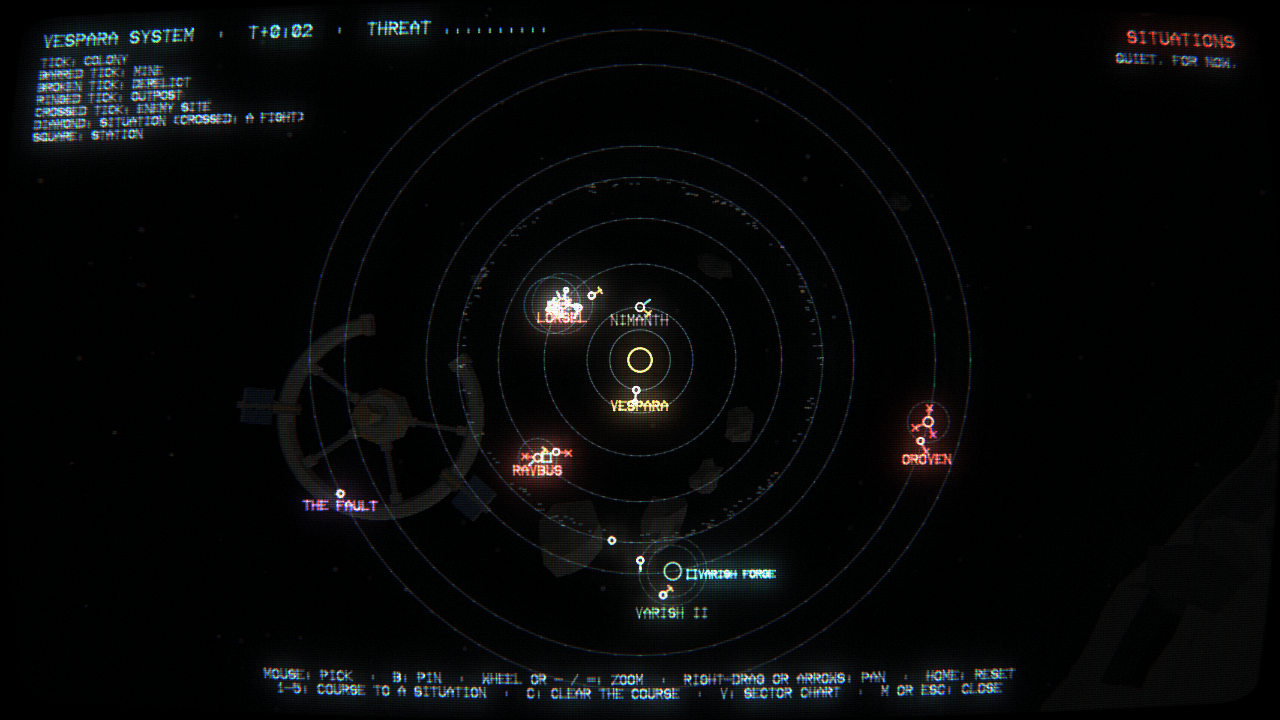
Procedural generation complicates this.
Replayability is lovely, but randomness can also make learning unnecessarily cruel. A novice player cannot build useful knowledge if the rug is pulled from under them every time they start a new game.
So the home system is generated within tighter rules.
Details may vary, but certain relationships and set pieces remain dependable enough for a new pilot to learn the game without having to rediscover reality from first principles every time.
Once you know what you are doing, those restrictions can be loosened. Veteran players can start elsewhere, including on the frontier, where the universe is under no obligation to be quite so considerate.
That balance matters to me: procedural generation should create uncertainty without making knowledge meaningless.

Building all of this has produced some fairly strange development problems.
A systemic economy, for example, is not especially useful if it collapses under ordinary play, and combat balance is difficult to judge from a handful of hand-played sessions. Tools such as Claude Code ended up being useful for building synthetic pilots with different behavioural tendencies, allowing me to run large numbers of simulated careers and look for things that break.
That subject deserves an article of its own, as do several of the other testing benches and systems that went into the game.
For now, though, Wildcatter ’82 is simply my attempt to answer a question I have probably been asking since I was a child:
What would an arcade space game from a 1982 that never happened look like if you built it today?
You can try the demo, the entire home system, here:
Website here.
If this sounds like your particular kind of nonsense, I would genuinely like to hear what you make of it.
Leave a Reply