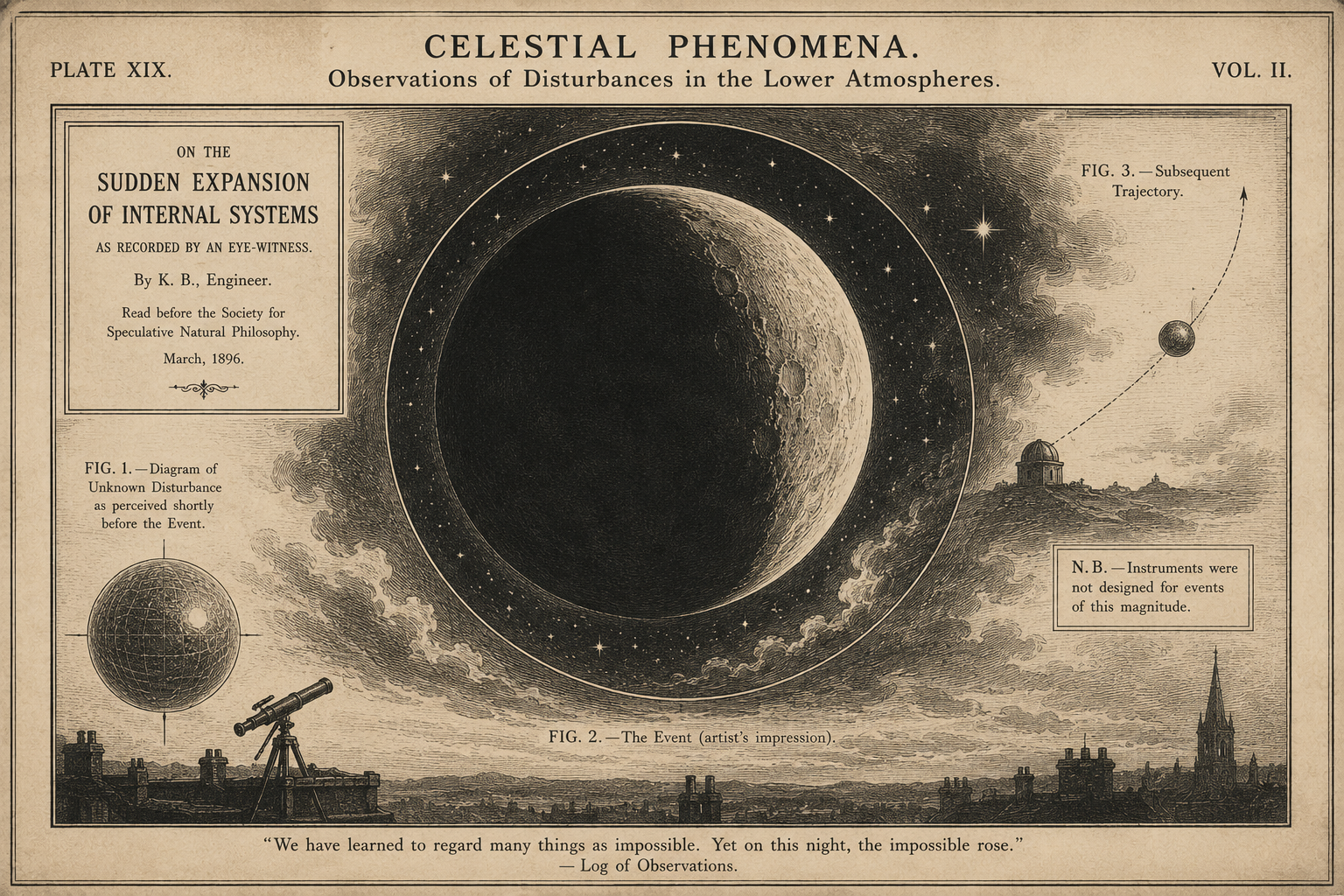
There are moments in life where one is forced to confront a terrible truth about the universe.
This was one such moment.
It began, as most modern catastrophes do, with optimisation.
You see, I have a tendency to chew gum while working. Particularly during long coding sessions where the mind slowly drifts into that strange state between engineering and sleep deprivation. The sort of sessions where one moment you are carefully reviewing system behaviour, and the next you are contemplating whether reality itself is simply a poorly documented edge case.
Now, in my defence, the gum in question was sugar free.
This is important because “sugar free” carries with it an implied moral superiority. It suggests restraint. Responsibility. Moderation. It whispers comforting lies such as:
“This is basically health food.”
And thus, secure in the knowledge that I had outsmarted both sugar and biology itself, I continued chewing.
One piece became several. Several became many. Many became… difficult to quantify.
Somewhere during this process, the distinction between “having gum” and “maintaining a continuous industrial polyol intake pipeline” quietly ceased to exist.
Outside, the world continued as normal. Cars passed by. The sea remained calm. Civilisation persisted under the false assumption that the universe still obeyed comprehensible laws.
Inside my digestive tract, however, something ancient had awakened.
At first, the symptoms were subtle. A minor pressure anomaly. Slight bloating. Nothing particularly alarming and certainly nothing worthy of interrupting the workflow.
But the human body, unlike software, has very firm opinions regarding undefined behaviour.
As the evening progressed, it became increasingly apparent that the bacteria inhabiting my digestive system had discovered fire. No, not merely fire. Civilisation. Somewhere deep within the abyssal darkness of the intestine, vast microbial empires were industrialising at terrifying speed upon a limitless influx of artificial sweeteners. Fermentation escalated beyond all ethical constraints. Gas production entered what can only be described as an arms race.
And still, I chewed.
At some point during the session, I rose from my Aeron chair to respond to what I believed was a minor gastrointestinal disturbance.
What I discovered instead was horrifying.
My abdomen had expanded to proportions that suggested either imminent childbirth or the early stages of stellar collapse. I stared downward in silence, attempting to reconcile the observed geometry with known physics.
It was at this precise moment that I realised I had made a catastrophic error.
Now, I should mention that earlier that day I had also consumed a considerable quantity of seeded bread. This detail, insignificant at the time, would later prove to be operationally relevant.
For those unfamiliar with the interaction between high-fibre foods and industrial quantities of polyols, allow me to summarise the experience succinctly:
Imagine if The War of the Worlds and a chemical weapons incident occurred simultaneously inside a confined biological ecosystem.
The human digestive tract is, under normal circumstances, a marvel of evolutionary engineering. Mine had instead become an active war zone.
And across the gulf of the abdomen, across which intellects vast, cool and unsentimental had long regarded this descending torrent of gum pellets with quiet, patient excitement, the reckoning finally arrived.
Yet so blinded was I by the false security of “sugar free” that I had pressed onward. Piece after piece. Tub after tub. Until at last, the first warning tremors began to stir beneath the waistband.
The ensuing hours are difficult to describe accurately without either violating several international conventions or traumatising the reader. Suffice it to say that by the climax of the evening, systems had failed, pressure had mounted, and the toilet had achieved orbit.
There is, I think, a lesson somewhere within all this, though not the one you might expect.
Not merely about polyols, though one should certainly regard the phrase “excess consumption may produce laxative effects” with the same seriousness normally reserved for reactor warning labels.
The real lesson is simpler, and older, and the same one that runs through every project I’ve ever touched: the warning signs were always there. The body, like any sufficiently complex system, will tolerate a great deal before it stops tolerating anything at all.
And then it stops all at once.
And so now, as I write this, two tubs of Orbit gum and three bags of VIVIL sweets sit quietly upon my desk. Waiting. Patient. Eternal.
I would like to say I have learned my lesson.
But then again…
the compile is taking a while.
Leave a Reply